
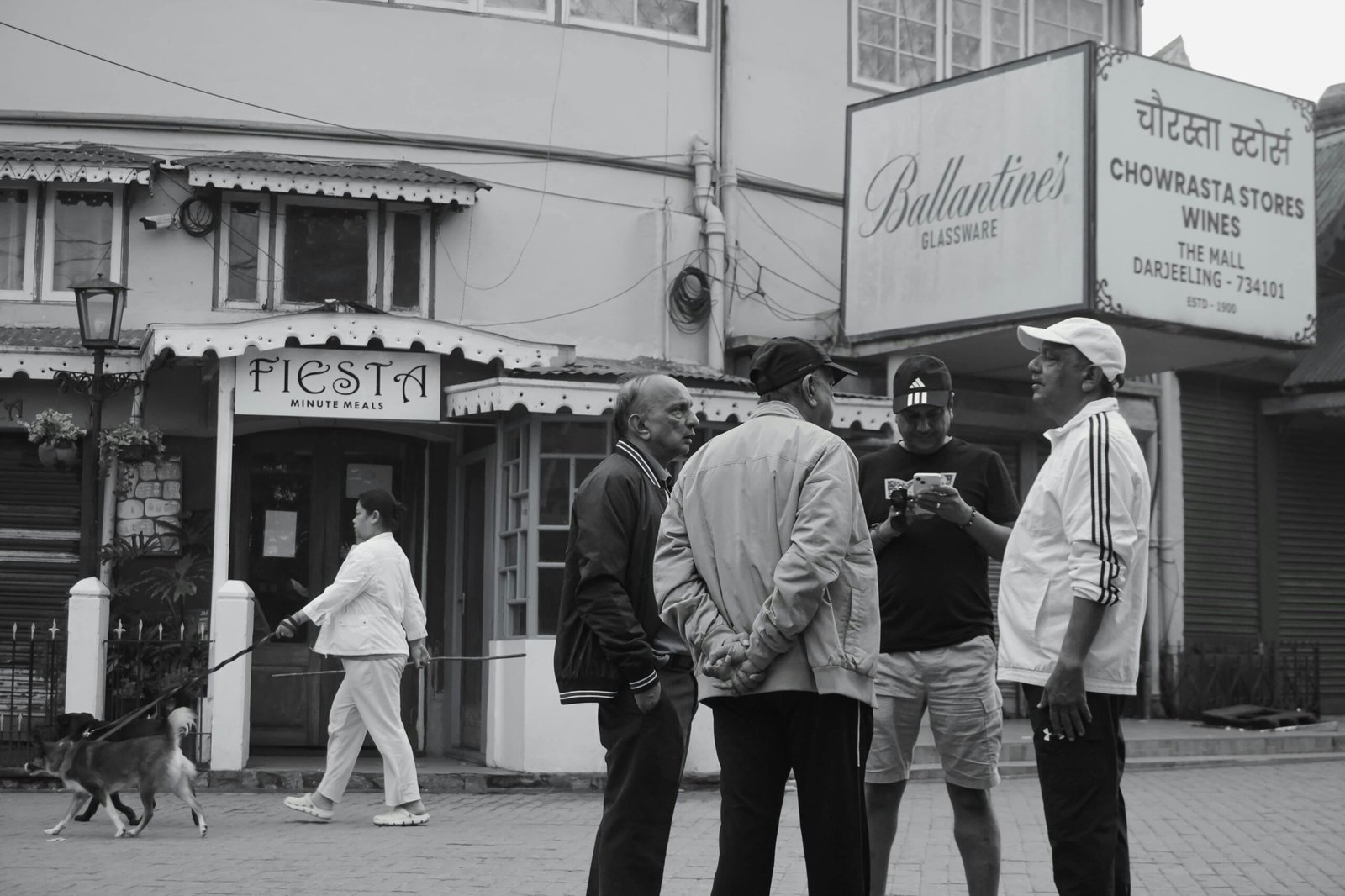
Words & Photography: Madhu Chaudhary // Additional Photography: Anima Biswal
On the map, the route looked deceptively simple: Bagdogra to Darjeeling, then onward to Pelling, Gangtok, and Kalimpong, before circling back. But a North East India road trip is never about straight lines. The mountains twist and fold upon themselves, hiding valleys and unveiling snow-dusted peaks without warning. Time itself felt elastic — mornings stretched endlessly, evenings dissolved in a blink.
Anima scribbled the line instantly. Some truths are meant to travel with you forever.
The Toy Train groaned and whistled its way towards Ghum, steam rising in ghostly spirals. From its window, the hills revealed themselves in flashes — pastel houses clinging to slopes, children in uniforms waving at strangers, tea bushes curving like green waves. Built in the 1880s, the Darjeeling Himalayan Railway is a UNESCO World Heritage Site, an engineering marvel that climbs nearly 7,000 feet using loops and zig-zag reverses instead of tunnels. It was once nicknamed the “toy train”because of its small engines and narrow gauge.
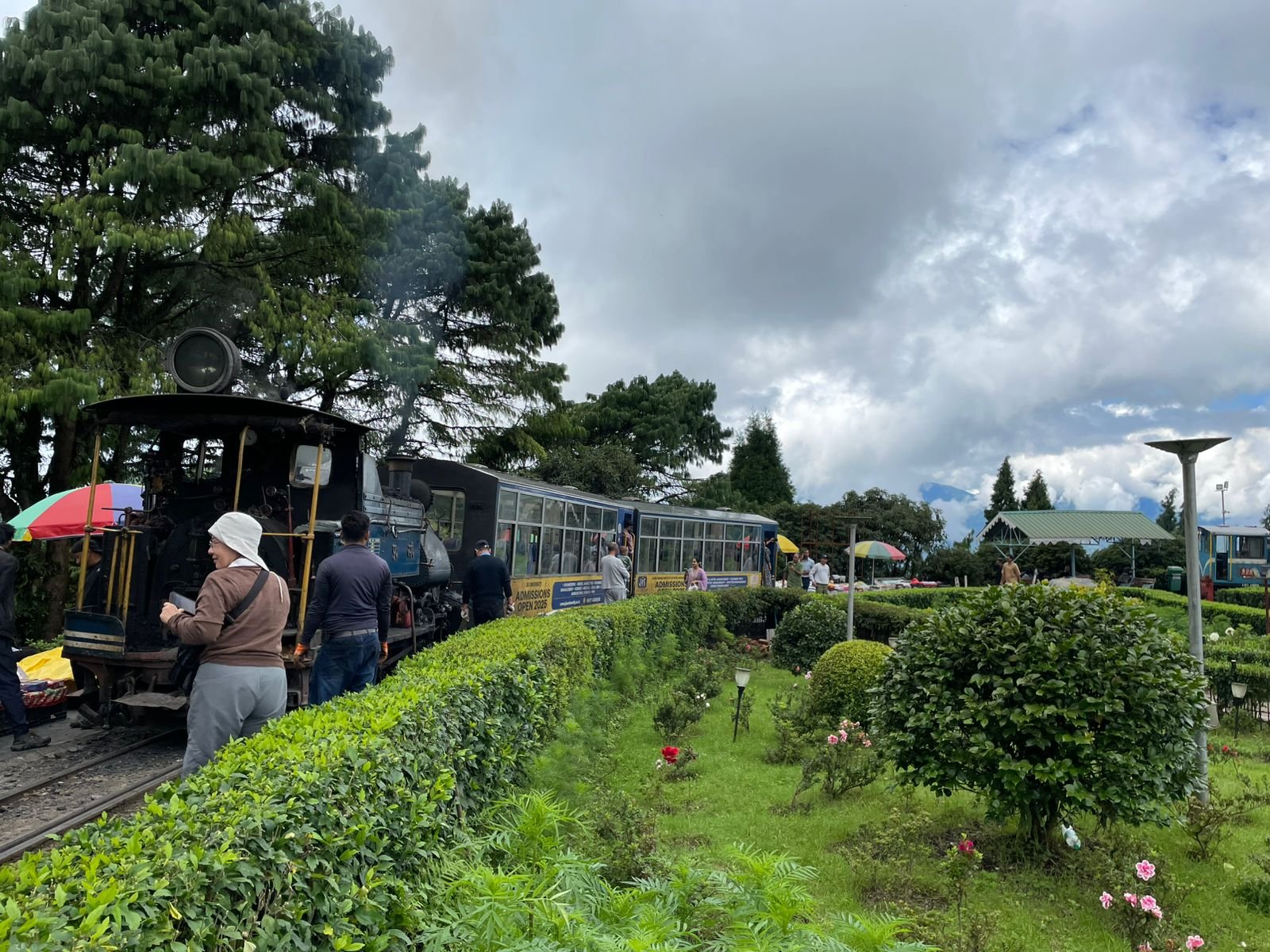
“Feels like another century,” Madhu whispered, her smile carrying the wonder of a child.
At Happy Valley Tea Estate, women bent low among the bushes, plucking leaves with practised grace. Established in 1854, it is one of Darjeeling’s oldest estates, still producing some of the most sought-after teas in the world. The guide spoke of Victorian parlours and distant ships, but it was the sound of baskets filling — soft, unbroken — that lingered with us.
Later, the Japanese Temple held us in stillness. Built by Nichidatsu Fujii, a disciple of Mahatma Gandhi, the Temple was part of his global mission to spread peace through Buddhist chanting and prayer. Chants rose and fell in unison, a drum marking the rhythm of devotion. Phones were forbidden, so every note etched itself straight into memory.
Sometimes, prayer doesn’t need translation.
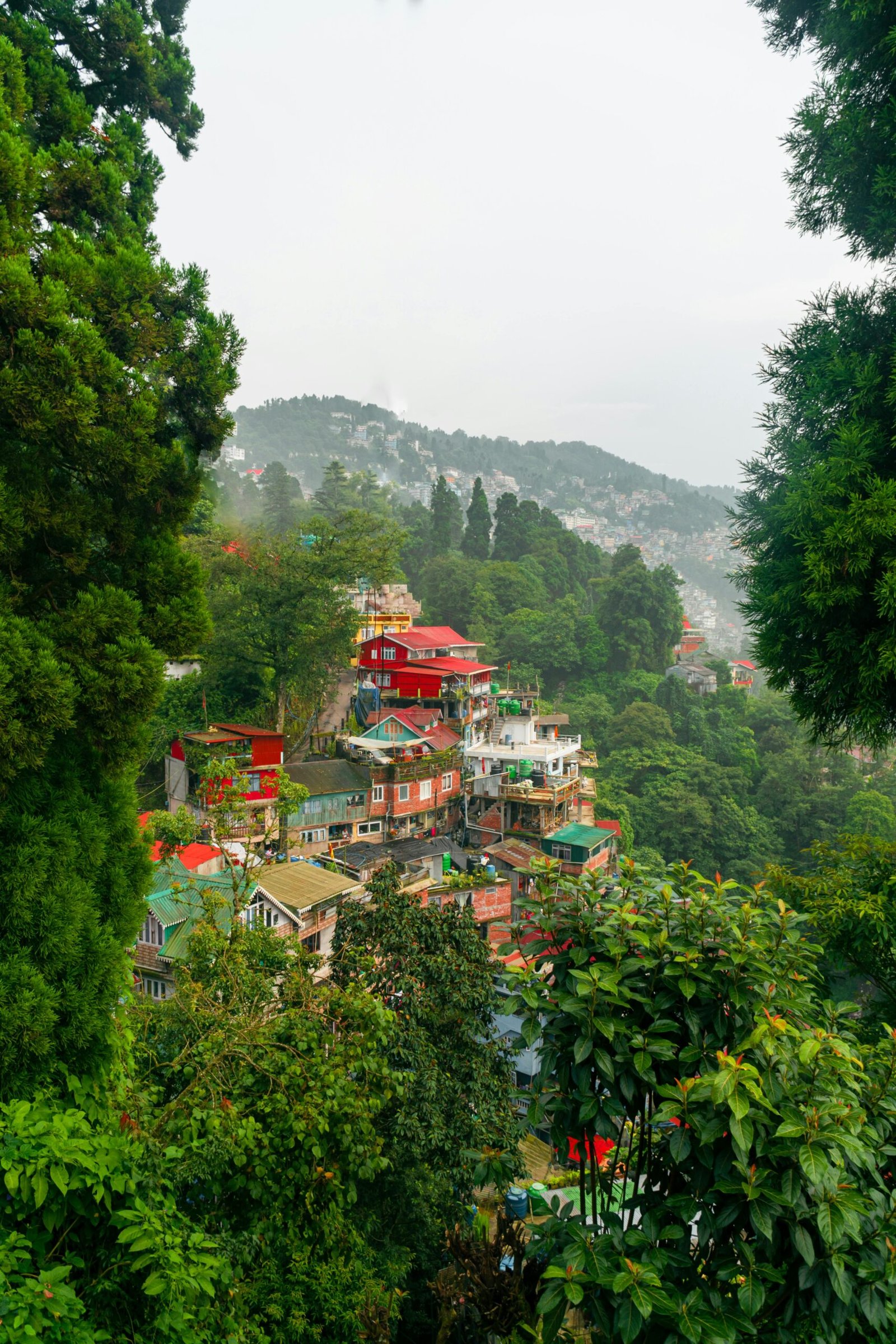
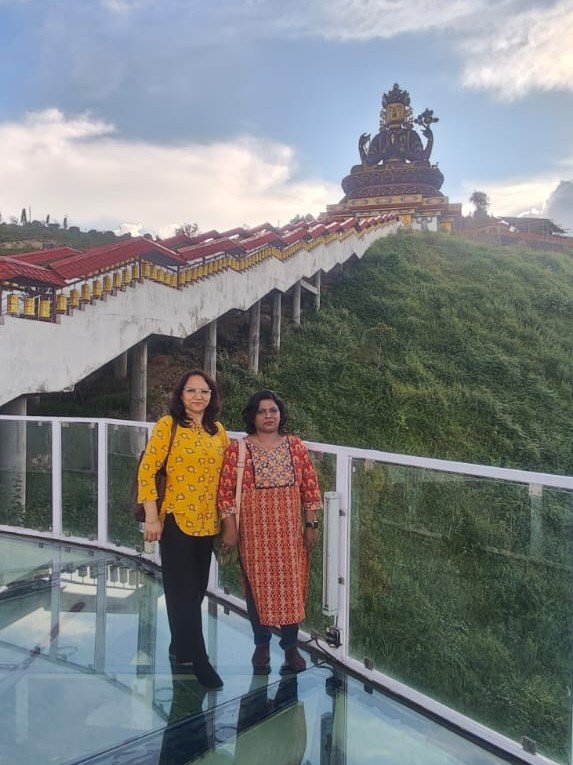
The Chenrezig Glass Skywalk stretched out into the void. Beneath us, transparent panels revealed the drop — a plunge into air that made my stomach tighten. But Madhu walked ahead slowly, her gaze fixed on the mountains rising like painted scrolls. The skywalk is India’s first glass-bottom bridge, built at a height of nearly 7,200 feet, overlooking the world’s tallest Chenrezig statue — the Bodhisattva of Compassion. It was inaugurated in 2018, but it already feels timeless, suspended between devotion and daring.
Nearby, volunteers scrubbed temple steps, their hands moving with patient devotion. No one hurried. No one looked for acknowledgement. Sonam watched for a moment and said softly:
That image — of hands polishing stone — stayed with us longer than the shining bridge.
At Pemayangtse Monastery, founded in 1705 and belonging to the Nyingma order of Tibetan Buddhism, incense lingered in the air. Inside stood the famed Sangtok Palri Zangdog, a seven-tiered wooden model of a celestial palace carved by a single lama over five years — a highlight of any Sikkim cultural tour.
Anima closed her notebook and smiled.
“We travel to collect stories,” she said. “Today, the stories collect us.”
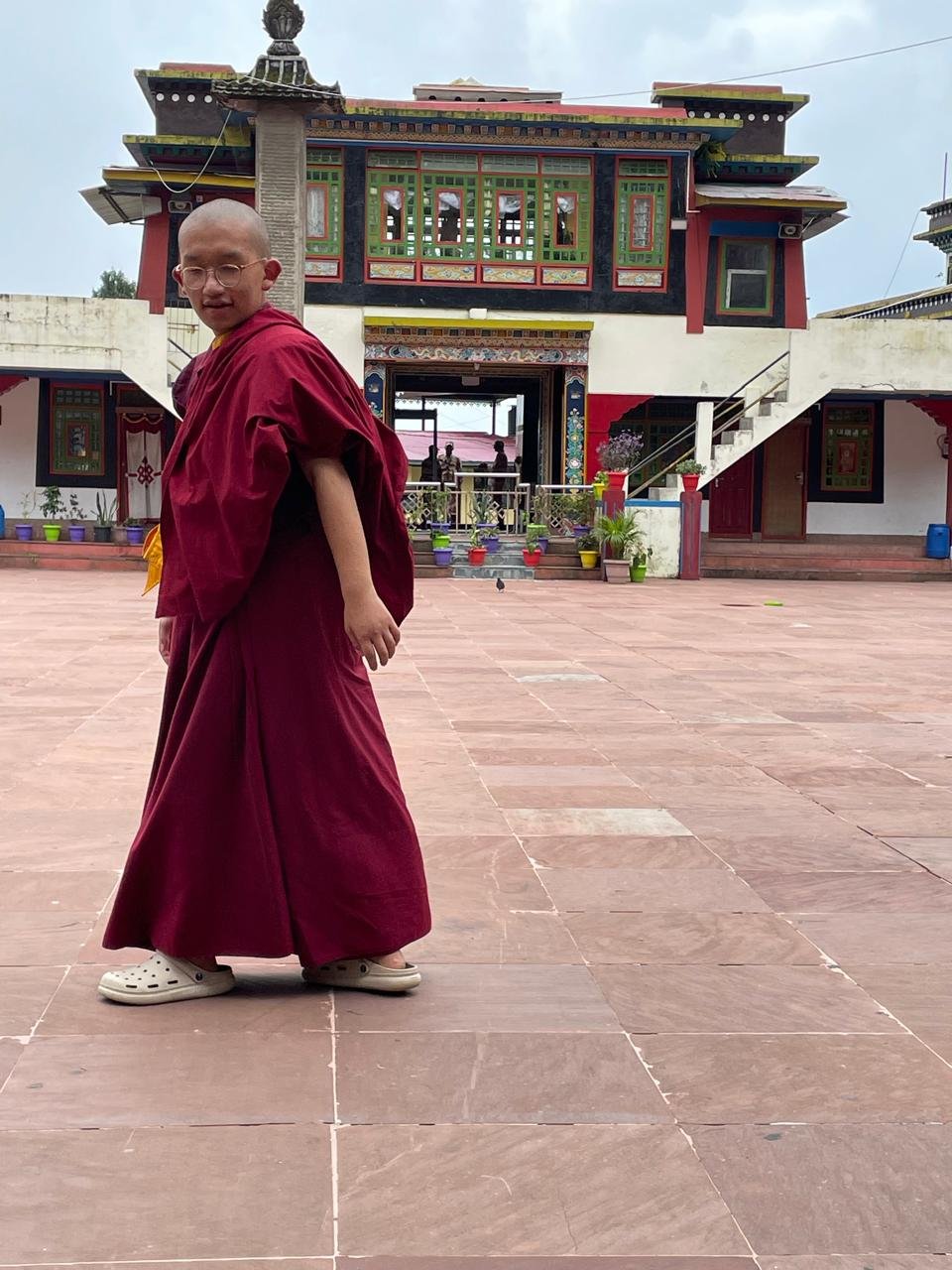
Gangtok, the capital of Sikkim, revealed layers of culture and belief. At Rumtek Monastery, rebuilt in 1966 by the 16th Karmapa, deep chants echoed through incense-filled halls. Today, it serves as the main seat of the Karma Kagyu lineage outside Tibet.
At Do Drul Chorten, pilgrims circled the stupa, spinning 108 prayer wheels that hummed with metallic mantras. The site enshrines sacred relics and is considered one of the most powerful spiritual landmarks in Sikkim.
Inside the Institute of Tibetology, manuscripts and thangkas rested in hushed rooms. It is one of the largest repositories of Tibetan culture in the world, preserving knowledge that might have otherwise been lost with Tibet’s occupation.
And then suddenly — Banjhakri Falls. Water thundered down rock cliffs, named after the ban jhakri, or “forest shaman,” of Sikkimese legend — spirits who were said to train shamans in their craft.
Later, at the Cottage Industry of Handicraft and Handloom, colours filled the halls — reds, saffrons, indigos, threads woven into Lepcha patterns. A craftsman explained how each motif carried meaning. Madhu touched a design with her fingertips and whispered:
Kalimpong arrived like a long exhale. The town stretched out without hurry, its streets quieter, its pace gentler. At Pine View Nursery, rows of rare cacti stood in strange contrast to the misty hills, their spines catching the light. With over 1,500 species, it is one of the largest cactus collections in Asia.
The morning took us to Durpin Monastery, built by the Dalai Lama himself, its white walls glowing in fading light. From Deolo Park, the highest point of Kalimpong, the panorama stretched across the Teesta River valley.
Every journey has a voice. Ours belonged to Sonam. Between bends, he told us about his childhood, about lottery tickets that everyone quietly bought, about lakes whispered to be sacred, about hills that carried hidden stories.
One evening, outside the Japanese Temple, as clouds drifted like slow-moving prayers, he said quietly:
“We clean the same steps monks do. We touch the same dust of the earth. Maybe that is our prayer.”
We exchanged a glance and let the silence remain. Some truths are complete without reply.
By the end of the week, Bagdogra pulled us back into the plains. Our bags were filled with souvenirs, our notebooks fat with scribbles — but the real weight of the journey was invisible. We carried mist-drenched mornings. The steady beat of chants. The kindness of strangers. And Sonam’s calm voice guided us through roads that bent and twisted, but never betrayed us.
Ruskin Bond once wrote:
Perhaps that is the truth. On this immersive North East India travel experience with Immerse India Tours, we arrived as visitors, wandered as travellers, and somewhere along those winding Himalayan roads, the hills quietly claimed us.
At Immerse India Tours, we curate immersive journeys across North East India that move at the rhythm of the land — thoughtfully designed, culturally rich, and deeply personal.
This is an excerpt from the field notes of the Immerse India team’s 2025 journey to the hills of North East, shared as part of our Immersive Experiences Series.
Words & Photography: Madhu Chaudhary